
EVENT
Cooperation that works: Civil Society in South-South and Triangular Cooperation
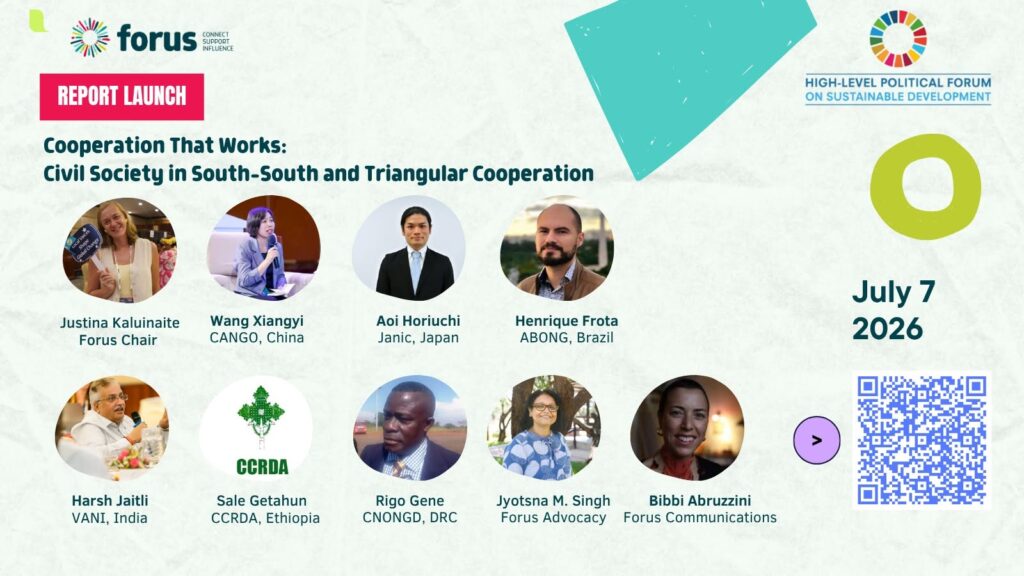
SAVE THE DATE – SSTC Report Launch – 7 July
Join the South- South and Triangular Cooperation Report Launch, a Forus side event to the HLPF 2026 !
 Register now!
-
When: Tuesday, 7 July
-
13:00 – 14:30 UTC (Click here to see your local time)

 Interpretation available in English, French and Spanish
Forus is delighted to invite you to the launch of its report “Cooperation that works: Civil Society in South-South and Triangular Cooperation”.
As the 2030 Agenda enters its final years, the international community is facing a difficult reality: SDG progress remains too slow, development finance is under pressure, trust in institutions is weakening, and cooperation models are not always reaching the communities most affected by today’s crises. The question is no longer only how to mobilise more resources, but how cooperation is designed, whose knowledge shapes it, and whether it is accountable to the people it is meant to serve.
South-South and Triangular Cooperation (SSTC) is increasingly recognised as an important pathway for accelerating sustainable development through solidarity, peer learning, shared experience and locally relevant solutions. At its best, SSTC can challenge top-down cooperation models and support more horizontal, context-responsive and politically legitimate forms of development cooperation.
Yet this promise is not automatic. Discussions and decision-making on SSTC continue to focus predominantly on governments, development cooperation agencies and international institutions. Civil society’s contribution to generating community evidence, connecting local realities to policy spaces, facilitating peer learning, adapting solutions, monitoring risks and strengthening accountability remains largely undocumented, under-recognised and under-resourced.
Drawing on evidence from Forus members across Africa, Asia and the Pacific, Latin America and the Caribbean, Europe and the Middle East, the Forus 2026 SSTC report demonstrates that civil society is already a significant actor within SSTC ecosystems. Civil society organisations, national platforms and regional coalitions facilitate peer learning, strenghten accountability, localise development solutions, support knowledge exchange, and help ensure that cooperation reaches communities most at risk of being left behind.
During the call, we will:
-
Present the report’s key findings
-
Highlight practical examples from different regions
-
Initiate a strategic conversation on what needs to change for SSTC to become more inclusive, accountable, locally grounded and fit for the final years of the 2030 Agenda, and for the cooperation framework that comes next.
Don’t miss this opportunity to take part in the SSTC Report Launch and generate momentum for policy discussions during HLPF 2026 and beyond!
Please, feel free to share this invitation within your network!
In solidarity,
The Forus Advocacy Team